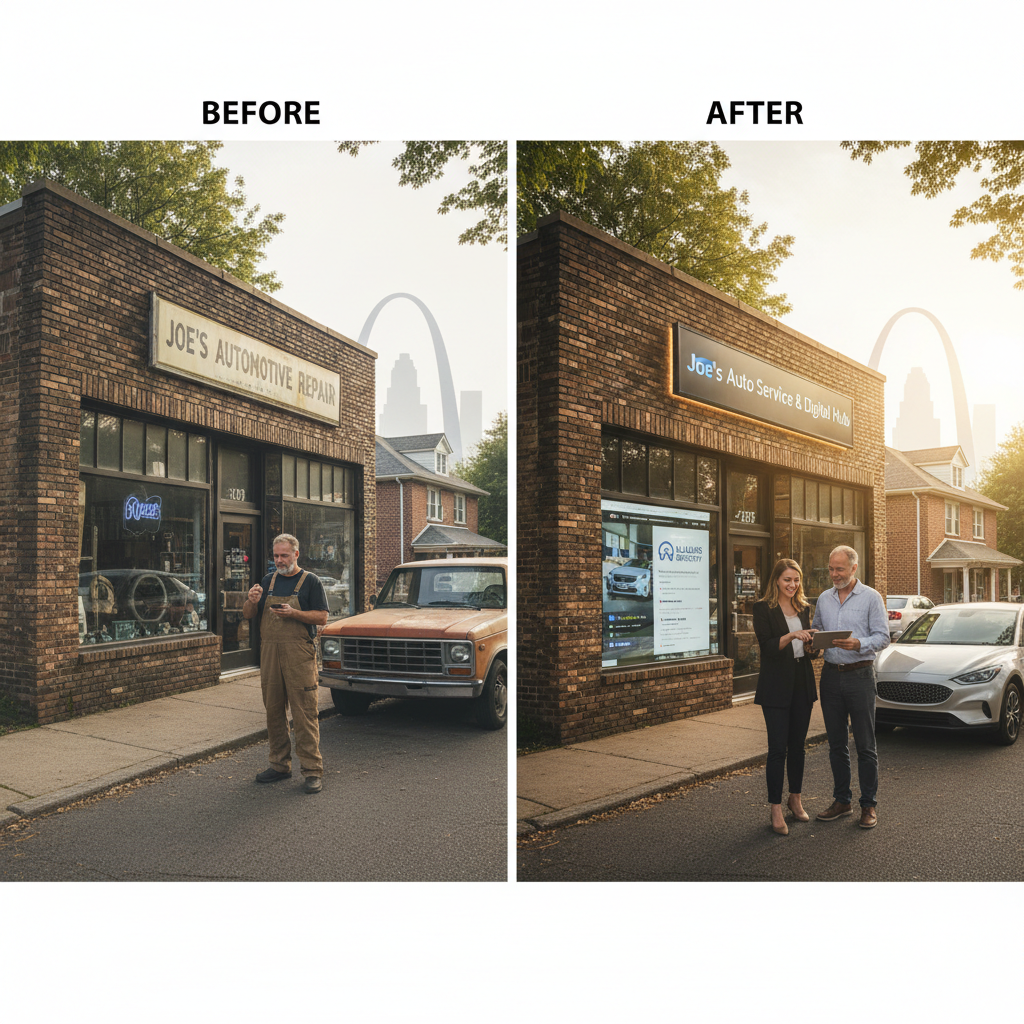
St Louis County Small Business Digital Transformation: Your Complete Implementation Guide
St. Louis Near Me Directory connects businesses with people searching for services in St. Louis and communities throughout Missouri and Illinois. Reach more cus
Small businesses across the St. Louis metropolitan area face a unique challenge: staying competitive in a digital-first marketplace while maintaining the personal touch that makes them successful. With over [83,000 business establishments](https://St Louis Near Me Directory.com) spread across Missouri and Illinois communities, the pressure to modernize operations and customer engagement has never been higher.
This complete resource hub addresses the specific needs of St. Louis County businesses looking to transform their operations without breaking the bank or losing their local identity.
Who This Guide Serves
This resource is designed for business owners in St. Louis, Clayton, Maryland Heights, Wentzville, Belleville, and Edwardsville — along with communities like University City, Kirkwood, Webster Groves, Florissant, Chesterfield, and O’Fallon — who recognize that digital transformation isn’t just about having a website anymore.
You’re likely here because you’ve noticed competitors gaining ground, customers increasingly expect digital convenience, or you’re spending too much time on manual processes that technology could handle better.
Understanding Digital Transformation for St. Louis Small Businesses
Digital transformation for small businesses means systematically replacing manual, time-consuming processes with technology that improves efficiency and customer experience. Unlike enterprise-level transformation that costs hundreds of thousands, small business digital transformation focuses on practical improvements that pay for themselves quickly.
At St Louis Near Me Directory, we’ve observed that successful digital transformation in the St. Louis metro follows a predictable pattern: businesses start with operational efficiency improvements, then expand to customer-facing technologies, and finally integrate everything into a connected system.
The Three-Stage St. Louis Small Business Digital Framework
Stage 1: Operational Foundation (Months 1-3)
Digital scheduling and appointment management
Cloud-based file storage and communication
Basic customer relationship management
Digital payment processing
Stage 2: Customer Experience Enhancement (Months 4-9)
Professional online presence and local search optimization
Automated customer communications
Online booking and service delivery
Digital marketing and community engagement
Stage 3: Business Intelligence Integration (Months 10-12)
Connected systems that share data automatically
Performance tracking and business analytics
Automated workflows between different tools
Advanced customer segmentation and targeting
The St. Louis County Digital Readiness Assessment
Before jumping into new technology, assess where your business stands today. Score yourself in each area (1-5 scale):
Current Technology Infrastructure
Communication Systems: Do you use professional email, cloud storage, and team messaging?
Customer Management: Can you quickly find any customer’s contact history and preferences?
Financial Processes: Are payments, invoicing, and bookkeeping mostly digital?
Marketing Presence: Do customers find you easily when searching online for your services?
Operational Efficiency Indicators
Scheduling: How much time do you spend coordinating appointments and availability?
Information Access: Can team members find business information from anywhere?
Customer Service: How quickly can you respond to customer questions and requests?
Data Backup: Would your business continue operating if your computer crashed tomorrow?
Scoring Guide:
32-40 points: Ready for Stage 3 integration and advanced systems
24-31 points: Strong foundation, focus on Stage 2 customer experience
16-23 points: Start with Stage 1 operational improvements
Below 16: Begin with basic digital infrastructure setup
Industry-Specific Digital Transformation Strategies
St. Louis County’s diverse business landscape requires different approaches based on industry needs. Here’s how digital transformation applies to major local business categories:
Professional Services (Legal, Accounting, Consulting)
Primary Focus: Client relationship management and document workflows
Implement secure client portals for document sharing
Automate appointment scheduling with calendar integration
Use digital signature platforms for contracts and agreements
Set up automated follow-up sequences for different service stages
St. Louis Advantage: Professional services in Clayton and downtown St. Louis benefit from integration with other professional networks and referral systems.
Home Services (HVAC, Plumbing, Electrical)
Primary Focus: Field service management and customer communications
Mobile apps for technicians to access job details and update status
GPS tracking and route optimization for service calls
Digital invoicing and payment collection at point of service
Automated review requests and reputation management
Local Consideration: Home service businesses serving areas from Wentzville to Belleville need systems that work across state lines and different municipal requirements.
Retail and Food Service
Primary Focus: Point-of-sale integration and customer loyalty
Modern POS systems that track inventory and customer preferences
Online ordering and delivery coordination
Loyalty programs that work both in-store and online
Social media integration for community engagement
Metro Integration: Businesses in areas like University City and Webster Groves can connect with local food delivery networks and community event platforms.
Healthcare and Wellness
Primary Focus: Patient management and compliance systems
Electronic health records (EHR) for patient information management
Online appointment scheduling with automated reminders
Telehealth capabilities for remote consultations
Insurance verification and billing automation
Regulatory Note: Missouri and Illinois have specific requirements for patient data protection that must be built into any digital system.
The 90-Day Digital Transformation Quick Start Plan
Based on our experience helping St. Louis businesses modernize, here’s a proven 90-day implementation timeline:
Days 1-30: Foundation Building
Week 1-2: Business Communication Setup
Move to professional email system (Google Workspace or Microsoft 365)
Set up cloud storage with proper folder organization
Install team communication platform (Slack, Microsoft Teams, or similar)
Week 3-4: Customer Data Organization
Choose and set up Customer Relationship Management (CRM) system
Import existing customer information
Create standard data entry processes for new customers
Days 31-60: Customer-Facing Improvements
Week 5-6: Online Presence Enhancement
Update Google Business Profile with current information and photos
Implement online scheduling system for appointments
Set up basic website or improve existing site for mobile users
Week 7-8: Payment and Service Delivery
Add digital payment options (Square, Stripe, or similar)
Create automated email confirmations and reminders
Implement basic review management system
Days 61-90: Integration and Optimization
Week 9-10: System Connections
Connect scheduling system to calendar and customer management
Set up automated workflows between different platforms
Implement basic reporting to track key business metrics
Week 11-12: Staff Training and Process Refinement
Train all team members on new systems
Document standard operating procedures
Collect feedback and make adjustments
Digital Tool Selection Guide for St. Louis Businesses
Choosing the right technology stack requires balancing functionality, cost, and ease of use. Here’s our evaluation framework:
Essential Business Categories and Top Options
Customer Relationship Management
Budget Option: HubSpot Free (0-1,000 contacts)
Mid-Range: Pipedrive ($14.90/user/month)
Full-Featured: Salesforce Essentials ($25/user/month)
Online Scheduling
Simple: Calendly (Free for basic features)
Service-Focused: Acuity Scheduling ($14/month)
Enterprise: BookingBug (Custom pricing)
Payment Processing
In-Person: Square (2.6% + 10¢ per transaction)
Online: Stripe (2.9% + 30¢ per transaction)
Full Service: PayPal (2.9% + fixed fee)
Communication and Marketing
Email Marketing: Mailchimp (Free up to 2,000 contacts)
Social Media: Hootsuite ($49/month) or Buffer ($15/month)
Customer Support: Zendesk ($19/agent/month)
Selection Criteria Framework
Integration Capability: Will this tool work with your other systems?
Scalability: Can it grow with your business over the next 2-3 years?
Local Support: Is there technical help available in the St. Louis area?
Data Ownership: Can you export your information if you need to switch?
Compliance: Does it meet Missouri and Illinois regulatory requirements?
ROI Calculation Framework for Digital Investments
Small businesses need to justify every technology expense. Here’s how to calculate return on investment for digital transformation projects:
Time Savings Calculation
Step 1: Track current time spent on manual processes (weekly) Step 2: Estimate time savings from automation (percentage reduction) Step 3: Calculate dollar value using this formula:
Weekly Hours Saved × Hourly Rate × 52 Weeks = Annual Time Value
Example: A Kirkwood accounting firm saves 5 hours per week on client communications through automated systems:
5 hours × $75/hour × 52 weeks = $19,500 annual value
Technology cost: $3,600/year
ROI: 442% return
Customer Acquisition Value
Track These Metrics:
Increase in online inquiries after digital presence improvement
Conversion rate from digital channels vs. traditional marketing
Average customer value from different acquisition sources
Customer retention rates with improved digital service
Efficiency Improvements
Common Measurable Benefits:
Reduced billing and payment processing time
Faster customer service response rates
Decreased errors in scheduling and data entry
Improved inventory management and cost control
St. Louis County Funding Resources for Digital Transformation
Several local and state programs provide financial support for small business technology adoption:
Missouri Small Business Development Centers
Free consulting services and low-cost training programs for technology adoption. Locations in St. Louis, Clayton, and surrounding counties offer personalized guidance for digital transformation planning.
Illinois Small Business Development Network
Serves businesses on the Illinois side of the metro area, including Belleville and Edwardsville, with similar consulting and funding guidance services.
SBA Technology Modernization Loans
The Small Business Administration offers several loan programs that can fund technology improvements:
SBA Express Loans (up to $500,000)
Microloans for smaller technology purchases
Equipment financing for hardware and software
Local Economic Development Incentives
Many St. Louis County municipalities offer business improvement grants that can cover technology upgrades. Check with your local economic development office for available programs.
Common Digital Transformation Mistakes to Avoid
After working with hundreds of St. Louis area businesses, we’ve identified these frequent pitfalls:
Technology Before Strategy
The Mistake: Buying software before defining what problems you’re trying to solve. The Solution: Start with process mapping. Document current workflows, identify pain points, then select technology to address specific issues.
Trying to Do Everything at Once
The Mistake: Implementing multiple new systems simultaneously. The Solution: Follow the three-stage framework. Master one system before adding the next.
Ignoring Staff Training
The Mistake: Assuming team members will figure out new technology on their own. The Solution: Budget 20% of technology costs for training and support.
Choosing Based on Price Alone
The Mistake: Selecting the cheapest option without considering integration and scalability. The Solution: Calculate total cost of ownership over 2-3 years, including setup, training, and potential switching costs.
Implementation Success Factors for St. Louis Businesses
Successful digital transformation requires more than just good technology. Here are the critical success factors we’ve observed:
Leadership Commitment
Business owners must actively participate in the transformation process. This isn’t something you can delegate entirely to staff or consultants.
Customer-Centric Approach
Focus on improvements that directly benefit customers rather than just internal efficiency. Customer-facing improvements generate faster ROI and build momentum for additional changes.
Data-Driven Decision Making
Track metrics before, during, and after implementation. Without baseline measurements, you can’t prove ROI or identify areas for improvement.
Local Market Understanding
St. Louis metro customers have specific preferences and behaviors that should influence technology choices. For example, businesses serving both Missouri and Illinois sides need systems that handle different tax requirements and regulations.
Advanced Integration Strategies for Established Businesses
Once basic digital transformation is complete, successful St. Louis businesses often move toward advanced integration strategies:
Business Intelligence Dashboards
Combine data from multiple systems into unified reporting that shows:
Customer acquisition costs by channel
Service delivery performance metrics
Financial performance trends
Staff productivity measurements
Automated Workflow Creation
Connect different systems so actions in one platform trigger responses in others:
New customer signup automatically creates service calendar entry
Completed service generates invoice and review request
Payment receipt triggers thank-you message and loyalty program update
Predictive Analytics Implementation
Use historical data to anticipate:
Seasonal demand fluctuations
Customer service needs
Equipment maintenance requirements
Staff scheduling optimization
Measuring Long-Term Digital Transformation Success
True digital transformation success extends beyond initial implementation. Monitor these indicators:
Operational Metrics
Process Efficiency: Time required to complete standard business tasks
Error Reduction: Decrease in mistakes related to scheduling, billing, or communication
Staff Productivity: Output per employee hour worked
Customer Satisfaction: Response times and service quality measurements
Financial Performance
Revenue Growth: Increase in sales attributed to digital improvements
Cost Reduction: Savings from automated processes and improved efficiency
Profit Margin: Overall business profitability improvement
Technology ROI: Return on digital transformation investments
Market Position
Online Visibility: Search ranking improvements and online presence strength
Customer Acquisition: New customers gained through digital channels
Competitive Advantage: Market share changes relative to competitors
Brand Recognition: Increased awareness and referrals
Industry Trends Shaping St. Louis Small Business Technology
Several technology trends particularly impact small businesses in the St. Louis metropolitan area:
Artificial Intelligence Integration
AI-powered tools are becoming accessible to small businesses through:
Automated customer service chatbots
Predictive inventory management
Intelligent scheduling optimization
Enhanced marketing personalization
Voice Search Optimization
Local voice search is growing rapidly, requiring businesses to optimize for questions like:
“Where’s the best plumber near me in Clayton?”
“What restaurants deliver to University City?”
“Who provides emergency HVAC service in Wentzville?”
Mobile-First Customer Experience
Mobile device usage continues to dominate customer interactions, making mobile optimization essential for:
Website design and navigation
Online appointment scheduling
Payment processing
Customer communication
Data Privacy and Security
Increasing regulations around customer data protection require small businesses to:
Implement secure data storage practices
Obtain proper consent for customer communications
Maintain compliance with state and federal privacy laws
Protect against cybersecurity threats
Frequently Asked Questions
Q: What are the 5 main areas of digital transformation for small businesses?
A: The five core areas are: 1) Customer relationship management and communication, 2) Financial processes and payment systems, 3) Marketing and online presence, 4) Operational workflow automation, and 5) Data analytics and business intelligence. Most St. Louis small businesses see the fastest ROI by starting with customer management and financial processes.
Q: How much should a small business budget for digital transformation?
A: Based on our experience with St. Louis area businesses, plan to invest 3-7% of annual revenue in technology over the first two years of transformation. This typically ranges from $3,000-$15,000 for most small businesses, spread across multiple budget cycles rather than a single large expense.
Q: What are the 7 pillars of digital transformation?
A: The seven foundational elements are: 1) Digital strategy alignment with business goals, 2) Customer experience optimization, 3) Operational process automation, 4) Data analytics and insights, 5) Technology infrastructure modernization, 6) Staff training and change management, and 7) Continuous improvement and adaptation.
Q: How long does digital transformation take for a small business?
A: Complete digital transformation typically takes 12-18 months for small businesses. However, you’ll see measurable improvements within the first 90 days if you follow a structured implementation plan. The key is starting with high-impact, low-complexity improvements before moving to more advanced integration.
Q: What are the 4 P’s of digital transformation?
A: The four P’s are: 1) People (staff training and change management), 2) Process (workflow optimization and automation), 3) Platform (technology selection and integration), and 4) Performance (measurement and continuous improvement). Success requires attention to all four areas simultaneously.
Q: Can small businesses compete digitally with larger companies?
A: Yes, especially in local markets like St. Louis County. Small businesses have advantages in customer relationships, local knowledge, and agility that larger competitors can’t match. The key is using technology to amplify these strengths rather than trying to compete on the same terms as national chains.
About St Louis Near Me Directory
St Louis Near Me Directory serves as the premier local business directory and digital marketing resource for the St. Louis metropolitan area, helping businesses across Missouri and Illinois connect with customers through enhanced online visibility and community engagement.
Our Gold, Platinum, and Diamond membership plans provide businesses with the digital foundation needed for successful transformation, including directory listings, Google Business Profile optimization, and automated marketing tools designed specifically for the St. Louis market.
For businesses ready to move beyond basic digital presence to become the definitive local authority in their industry, our Authority Tier provides comprehensive digital dominance strategies.
Ready to start your digital transformation journey? Contact St Louis Near Me Directory at (314) 756-8500 or visit our membership plans page to begin with a 7-day free trial.
Serving businesses throughout St. Louis, Clayton, Wentzville, Maryland Heights, Belleville, Edwardsville, and surrounding communities across the metropolitan area.